Horizontal 80-30m Fan Dipole
Description
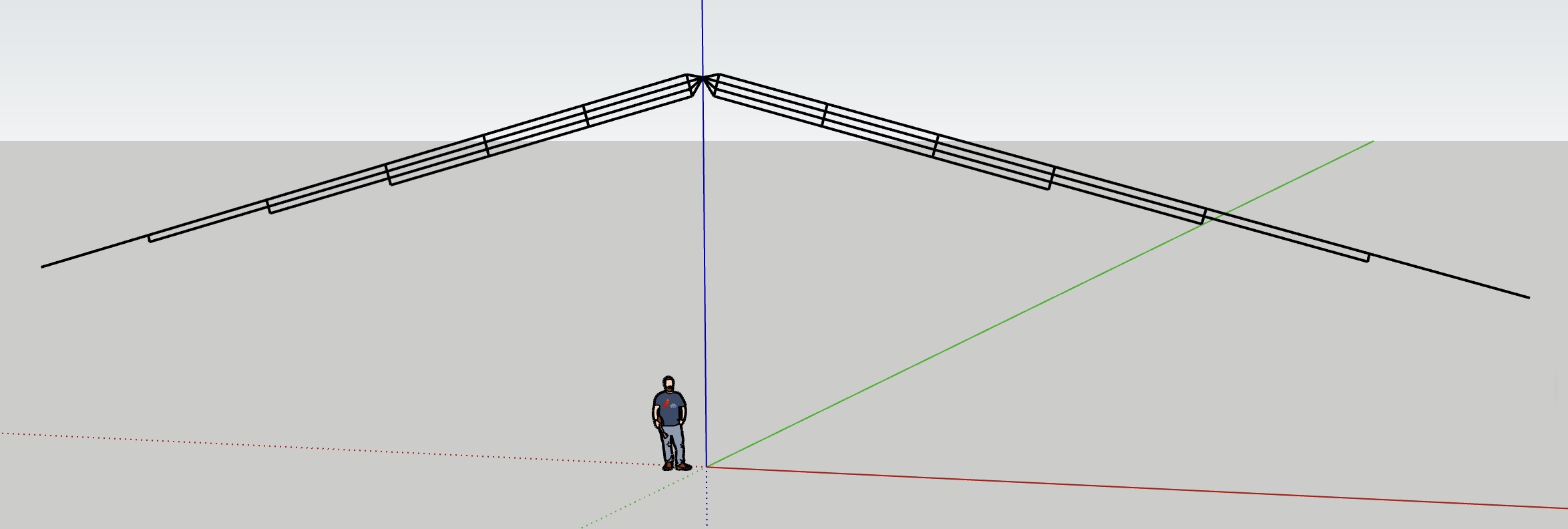
The rationale for this antenna build was to create a permanent NVIS-focused multiband dipole for the QTH station. Looking at NVIS propagation, typical antenna heights are suggested to be in the 0.1λ and 0.25λ range above ground. Given that the 80-30m bands are the typical NVIS-capable bands, this band selection was obvious.
In order to limit the size of the antenna, linear loading was used on the 80m element. Without linear loading, the element would be in the 38-40m bracket. In this antenna, the 80m element was limited to 32 meters, with about 9m fold back on each element.
Most outdoor wiring on this station uses Messi & Paoloni Ultraflex 2 coax — the standard coax type for outdoor runs.
A quarter-wave vertical covering 80-10m is also planned for the station, though not yet built.
Dimensions
| Band | Frequency | Reference Length | Length (with end effect) | Linear Loading | Actual Length |
|---|---|---|---|---|---|
| 80m | 3.5-3.8 MHz (3.65 MHz) |
20.5 m | 19.5 m | 16m, 9m fold back | To be measured |
| 60m | 5.258-5.4065 MHz (5.33 MHz) |
14.2 m | 13.5 m | — | To be measured |
| 40m | 7.0-7.2 MHz (7.1 MHz) |
10.5 m | 10.0 m | — | To be measured |
| 30m | 10.1-10.15 MHz (10.125 MHz) |
7.4 m | 7.0 m | — | To be measured |
Result
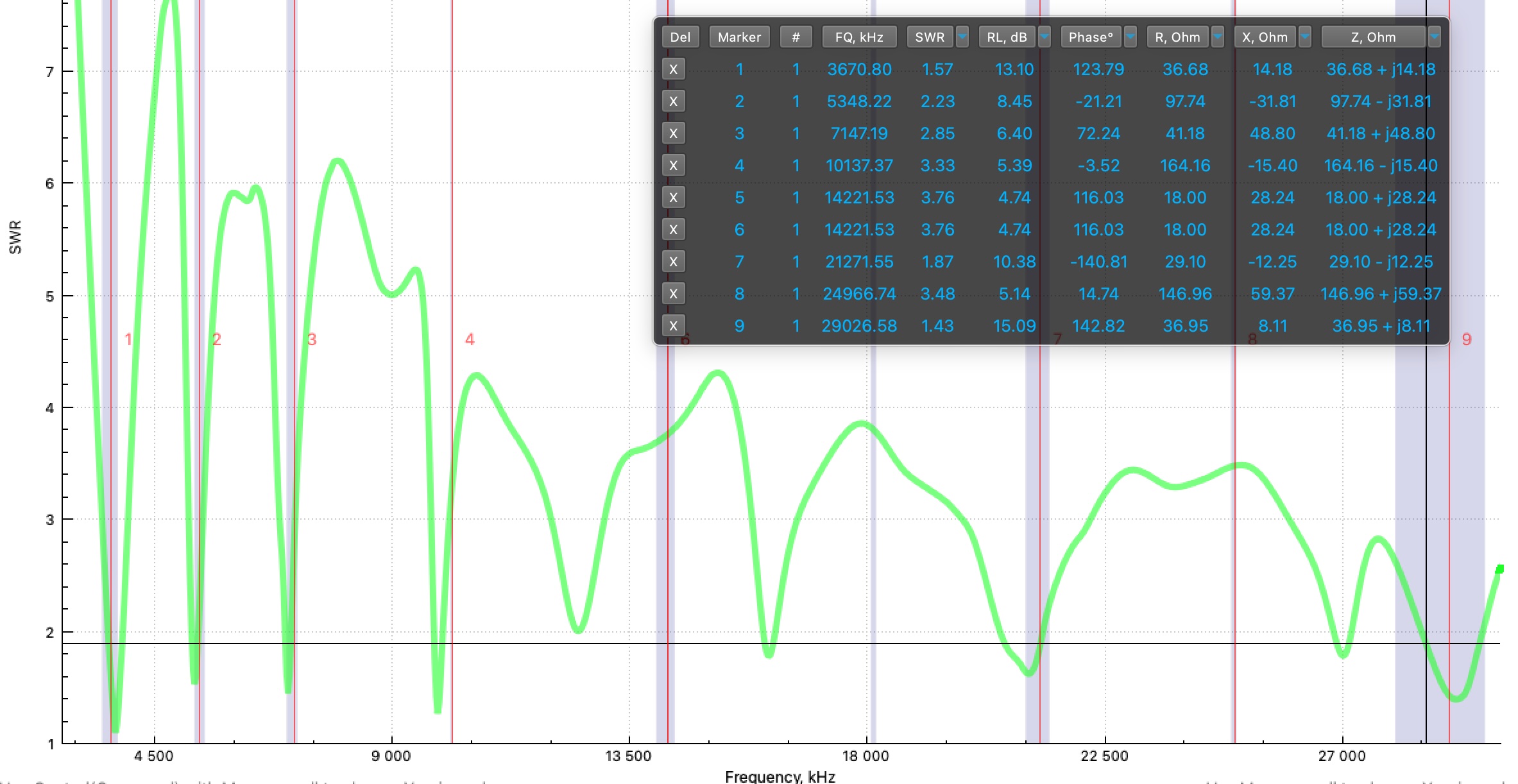
After construction of the antenna, I initially mounted it in the middle of the garden on open grass. This allowed me to easily access all parts of the antenna during tuning. I tuned it almost perfectly for the center of each band.
I then moved the antenna to its permanent location: a slightly raised area at the edge of the garden, surrounded by trees and dense vegetation. I used one of the trees to install a pulley system, allowing the antenna to be raised and lowered when needed.
Unfortunately, this new environment significantly detuned the antenna across all bands. I will therefore need to perform a new tuning session once temperatures rise again.
Nevertheless, the antenna remains perfectly usable on its designed bands using the Yaesu FT-710 internal tuner. Against expectations, I can also successfully tune it with the FT-710 tuner across all other decametric HF bands — a very nice bonus.